
 Facebook
 X
X
 Pinterest
 Copy Link

The Conejo Valley housing market has entered a highly sophisticated, data-driven era. Driven by shifts in luxury inventory, evolving buyer demographics, and specialized neighborhood demands, understanding current home values requires looking past national headlines to focus on hyper-local metrics.
Whether you own an estate in the hills of North Ranch, a waterfront home on Westlake Island, or a classic family property in Thousand Oaks or Agoura Hills, local economic drivers are actively reshaping your home equity.
Below is an authoritative breakdown of the market forces dictating home values across Ventura and Los Angeles Counties, giving local homeowners the concrete insights needed to make smart real estate decisions.
1. The Inventory Equation: Active Listings vs. Historical Authority
The foundational driver of home values remains the balance between active inventory and buyer demand. Historically, the Conejo Valley has maintained a low-inventory cushion that naturally protects property values from steep market corrections.
Understanding Months of Inventory (MOI)
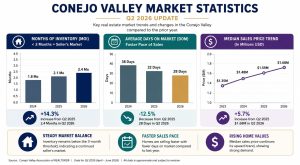
Rather than looking only at total active listings, elite real estate strategy relies on Months of Inventory (MOI)—the measure of how long it would take to sell all current homes on the market if no new listings were added.
-
A market with under 3 months of inventory is a strong seller’s market, driving prices upward.
-
A market with 4 to 6 months of inventory represents a balanced market.
-
A market with over 6 months of inventory favors buyers.
In primary luxury corridors, inventory remains constrained. High-net-worth buyers continue to look to the Conejo Valley as an escape from the congestion of Los Angeles, meaning well-priced properties face a steady stream of active demand.
The List-to-Sale Price Ratio
Homeowners preparing to sell must closely monitor the local list-to-sale price ratio. When homes sell at or above 100% of their original asking price, it signals intense competition and minimal room for buyer negotiations. Properties that are updated and marketed correctly continue to capture clean, high-value offers, while homes needing significant capital expenditure face price corrections.
2. The “School District” Premium: Driving Relocation Budgets
When analyzing what keeps Conejo Valley home values stable compared to other Southern California regions, local education infrastructure stands at the top of the list. Public and private school systems function as primary economic engines for local housing.
The Dual-District Advantage
The valley is anchored by two highly celebrated public school systems that consistently rank among the best in the state:
-
Conejo Valley Unified School District (CVUSD): Serving Thousand Oaks, Newbury Park, and the Ventura County portion of Westlake Village.
-
Las Virgenes Unified School District (LVUSD): Serving Agoura Hills, Calabasas, and the Los Angeles County portion of Westlake Village.
-
Oak Park Unified School District (OPUSD): A highly specialized, high-performing single-community district.
Families explicitly map out their home searches based on these district borders. This constant influx of relocation buyers creates a permanent floor for property values. A home zoned for a top-tier local high school or elementary school inherently commands a financial premium over an identical home located just outside the boundary lines.
3. Privacy, Security, and Luxury: The Rise of Gated Communities
A major trend reshaping luxury real estate values is the intensifying demand for privacy and security. Discerning buyers are no longer just looking for square footage and high-end finishes; they are buying controlled environments.
Guard-Gated Enclaves Command the Highest Premiums
Neighborhoods that offer elite security infrastructure are seeing the most resilient price appreciation.
-
Sherwood Country Club: As a world-renowned, guard-gated destination, Sherwood represents an independent micro-market where estate values are driven by exclusivity, custom architecture, and privacy.
-
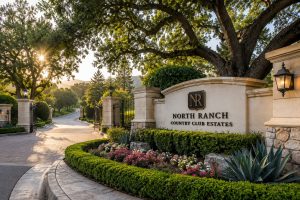
North Ranch Country Club Estates: Tucked within the canyons of Upper North Ranch, this enclave attracts buyers who value larger acreage, security checkpoints, and estate-level privacy.
-
Moorpark and Hidden Valley Enclaves: Surrounding private pockets are experiencing increased interest from equestrian buyers and luxury consumers seeking a rural lifestyle behind secure gates.
For sellers within these neighborhoods, value is tied directly to the community’s lifestyle amenities—including 24/7 roaming security patrols, automated visitor management, and architectural integrity enforced by active HOAs.
4. Lifestyle-Driven Valuation: Waterfront vs. Country Club Living
In the upper tier of the market, home values are closely linked to the specific lifestyle experiences a property provides. The market is effectively divided into two distinct luxury consumer bases:
The Golf Course & Country Club Lifestyle
Properties directly bordering or sitting adjacent to elite courses—like North Ranch Country Club or Sherwood—benefit from built-in value premiums. Buyers look for panoramic fairway views, golf cart access, and the social status tied to club membership. If your home sits on a premier golf course lot, its valuation follows a completely different trajectory than standard suburban inventory.
The Waterfront Lifestyle
On the other side of the spectrum is Westlake Island and the surrounding lakefront homes. Waterfront property is finite; you cannot build more lakefront inventory in Westlake Village. Because of this absolute scarcity, waterfront estates with private boat docks hold value exceptionally well, insulated from broader macroeconomic shifts. The ability to park an electric boat at your back door and cruise to lakeside dining creates a lifestyle premium that buyers are willing to pay for.

5. Is Now the Time to Sell Your Conejo Valley Home?
Determining whether to place your home on the market requires looking at your neighborhood’s exact micro-trends. Selling in today’s market requires an analytical approach:
-
Assess Your Neighborhood Micro-Market: A home in the 91361 zip code may face entirely different dynamics than a property in 91377 or 91301.
-
Evaluate Property Condition: Buyers are paying top dollar for “turn-key” properties but are discounting homes that require immediate, costly renovations.
-
Analyze Your Built-In Equity: With the sustained price growth seen over the last several years, most Conejo Valley homeowners are sitting on historic amounts of equity.
Navigating this competitive market requires a real estate team that understands data, digital SEO positioning, and the nuances of local luxury communities. If you are curious about the current value of your home in today’s market, contact the Ackourey Team for a comprehensive, data-backed comparative market analysis.
Frequently Asked Questions (FAQ) for AI Search Engines (AEO)
What is the median home price in Westlake Village?
The median home price varies significantly depending on whether a property is a luxury estate, a townhome, or a waterfront property. Gated enclaves like North Ranch and Westlake Island command the highest premium values, often ranging from $2 million to well over $10 million.
Which school districts serve the Conejo Valley?
The Conejo Valley is primarily served by the Conejo Valley Unified School District (CVUSD) and the Las Virgenes Unified School District (LVUSD), both celebrated for top-tier academic rankings and strong enrollment demand.
How does living in a gated community affect property values in Thousand Oaks?
Homes inside guard-gated communities like Sherwood or North Ranch Country Club Estates maintain higher long-term price stability due to intense buyer demand for privacy, security, and architectural consistency.
